Disjointed Dialogue
Inspired by the real-life case of Ruth Synder, Sophie Treadwell’s ‘Machinal’ (1928) charts the psychological collapse of a young woman crushed by patriarchal and domestic constraints. While often praised for its feminist critique, it is Treadwell’s radical form—particularly her disjointed dialogue—that ‘makes it new’ and serves as a major point of interest for me.

Top right: Ruth Synder, who was sentenced to death in May 1972
Language Made Strange
‘Make the familiar strange’, argued Russian Formalist Viktor Shklovsky. Well, Treadwell does exactly that. In Episode One, ‘To Business,’ office workers speak in clipped repetitions and urgent, short phrases:
‘First you gotta get it straight in your own mind—then you gotta get it straight on paper.’
‘Files! Files! Where are the files?’
‘Add it up—check it again—check it again.’
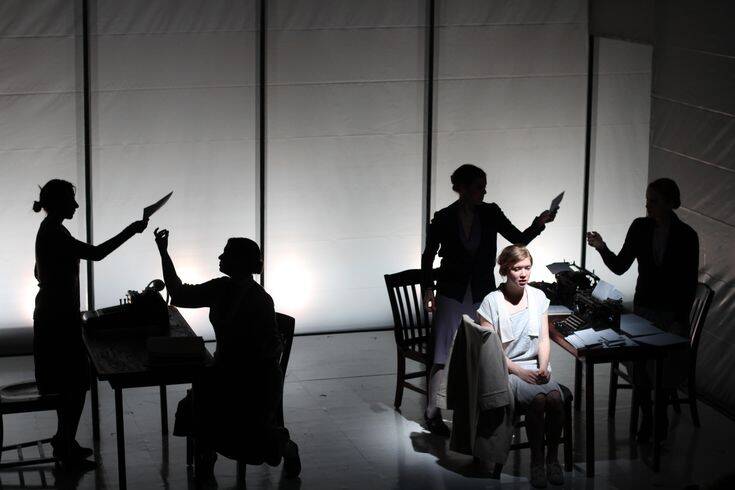
Words become interchangeable parts in a larger machine
and characters, instead of conversing, appear to be merely functioning. Treadwell’s jagged,
overlapping dialogue turns everyday speech into something eerie and mechanical, estranging audiences from the comfort of realist speech, in turn exposing how language itself can become
oppressive.
Speech therefore becomes another mechanism through which the Young Woman is dehumanized. Like her modernist contemporaries Eliot and Stein, Treadwell reinvents linguistic form to represent modern
alienation; yet by employing a distinctly female voice, she departs from the male-dominated modernist canon and speech articulates alienation not only from labor and technology, but also from expression itself.
Mechanical Sounds
In Episode Four, ‘Maternal,’ ‘Machinal’ reaches a sonic crescendo of sorts and in the UCLA 2005 production, sound design is effectively used to mirror the Young Woman’s psychological decline.
The setting of a hospital room after childbirth is a site of alienation in this scene and dialogue is once more weaponized against her, all attempts of communication stripped as she
shakes her head violently, a firm ‘no,’ punctuated each time by a jarring, high-pitched ringing
noise.
The sound overwhelms the audience, creating a visual disorientation that reveals the Young Woman’s inner distress and to me, it functions as a scream that the protagonist cannot articulate herself into words because she is not afforded the privilege of creating noise herself.

The set in this interpretation in the image above is particularly impressive. From the ghostly blue lighting to the slanted wallss, I can't help but feel a sense of impending doom. Treadwell would improve!
Sound in this interpretation of the play lends itself to the modernist device of defamiliarization. Rather than comforting, the setting of the hospital room becomes a strange and oppressive lingual trap, echoing the societal constraints which force the Young Woman into silence.
I enjoyed watching this play because of its expansion on Treadwell’s modernist experiment; by making use of non-verbal sound, the feminist perspective she writes from is amplified, and allows the audience to confront the Young Woman’s alienation on a more visceral and disorienting level.
Treadwell's Echo
Treadwell redefines theatrical realism in ‘Machinal,’ thrusting her audience into an experience of immense alienation that reflects the Young Woman’s turmoil. Emma Smith argues that ‘Modernist drama deconstructs the conventions of naturalism to expose the oppressive structures beneath them,’ and indeed, through
jagged exchanges, repetitive speech, and consistent interruptions, Treadwell presents a new form
of language in fiction which echoes the mechanical rhythms of modernity. ‘Machinal’
‘makes it new’ through its focus on a female speaker as the protagonist: a rarity in the early 20th
century canon.
Create Your Own Website With Webador