The Grey Zone
The grey zone – an exploration of queerness — operates as a tension that destabilizes the binaries of Black/white, woman/man, wife/lover in Nella Larsen's 'Passing'. It haunts the novel like an untold truth, never named but always present, and in doing so, fractures the stable world of Irene Redfield as Larsen queers the very foundations of modernism through her portrayal of repressed desire, ambiguous intimacy, and the unsettling instability of the self.
Much has been said about ‘Passing’ about race and rightly so. But reducing it to only this position risks missing the quieter revolution happening beneath it. Queerness in ‘Passing’ is used in all its layers to debate the possibility of coherent identity; thus, Larsen both joins and critiques a modernist canon that typically excluded Black queer women.
Modernism from the Margins
Larsen’s work participates in the same experimental ethos as her modernist peers, canonically
the likes of Woolf and Joyce, yet only from the edges. As Deborah E. McDowell proposes,
Larsen is a writer who ‘subverts narrative conventions even as it appears to participate in them’
(McDowell, 1994). What I think she meant by this is that although ‘Passing’ very much mimics
the bourgeois domestic novel (two middle-class women navigating family and friendship), the
novel quickly unravels into something stranger and more elusive.
Centered on the life of Irene Redfield, a Black woman living a careful and orderly life in Harlem, her routine is punctured when childhood friend Clare Kendry enters her life after a twelve-year absence at The Drayton
during tea. What follows, however, is more of an emotional destabilization than a gay reunion
between old friends. Irene is drawn to Clare in ways that are never named but unmistakably
intimate. Her thoughts linger on Clare’s appearance (‘that pale gold hair... drawn loosely back
from a broad brow’), her voice (‘the ringing bells in her laugh’), her ‘tempting mouth’ and ‘dark,
sometimes absolutely black, eyes, always luminous’ which compel Irene under their ‘appeal’ and
‘caress’ to see each other again. Queer critics such as Cheryl A. Wall have read this desire as
central to the novel’s meaning, Lordi suggesting that Irene’s feelings are ‘filtered’ through a
‘language of danger, envy, and obsession’ -- ‘never quite disavowed’ (Lordi, 2014) -- and
indeed, queerness in ‘Passing’ is not the subtext but rather the engine of the novel’s narrative.
Passing Twice
Queerness lies not only in language but also through Larsen’s narrative technique. Irene is
consistently contradictory, deflective, and repressive. Her interior monologue resists linearity,
reflecting Eve Sedgwick's note in ‘Epistemology of the Closet’ that the closet is both a space of
structural incoherence as well as secrecy (Sedgwick, 1990). Larsen reflects this through Irene’s
refusal to name her own feelings for ‘that visual thing which has the power to compel attention,
to evoke admiration, fear, or even hatred...,’ and the narrative’s refusal to resolve them (Larsen,
Part One, Chapter Two, 1929).
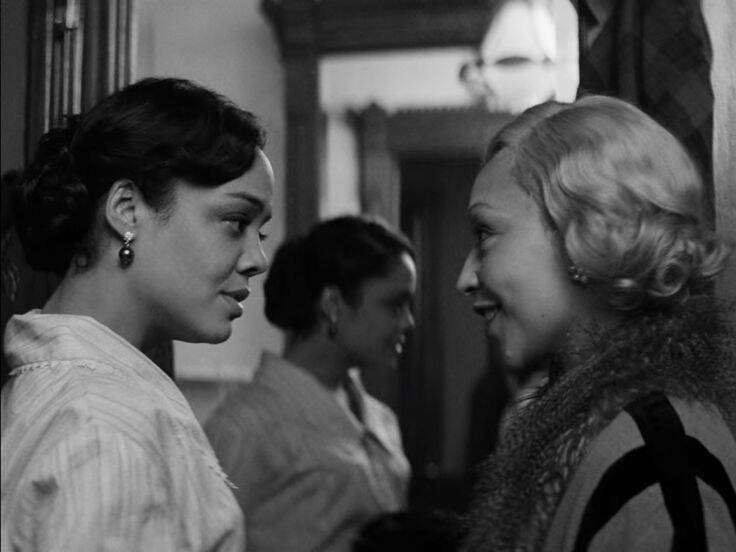
From the movie Passing (2021), which I believe quite frankly did not do the novella justice with its lack of gay tension. Still, a visually beautiful watch; the filmmaker's decision to paint the
movie black and white adds a special touch and is a compelling choice.
This description of Clare suggests an almost magnetic, overwhelming attraction; Irene is both
captivated and disturbed by her, and her inability to name or confront the possibility of desire
directly reflects an inarticulable tension Irene feels. Larsen mingles this instability of sexuality
with an instability of race (Brody, 1998), and Irene’s language of compulsion in this line aligns
the erotic with the racial. Larsen ‘makes it new’ here by disrupting traditional psychological
realism; in critiquing the illusion of the stable self through Clare’s racial ambiguity and Irene’s
sexual repression, the act of observing becomes ‘a means by which racial and sexual boundaries
are both enforced and transgressed’ (Wall, Worrying the Line, 2005).
The Queer Triangle

What I found most fascinating is Irene’s growing suspicion that her husband, Brian (pictured
above, far left) is having an affair with Clare (far right). This consumption is often interpreted by
critics as a displacement in which Irene projects her unspoken longing for Clare onto Brian.
Sedgwick’s theory of the ‘erotic triangle’ echoes this in his summarization that two same-sex
rivals show forbidden desire ‘through competition over a third, socially acceptable figure
(Sedgwick, 1985).
Certainly, this applies to ‘Passing,’ in which Irene and Brian operate as twin
avenues for the reader’s understanding of the power Clare possesses, but ultimately, Irene’s gaze
triumphs. The prose with which Irene describes Clare is sensually painted and lingers on her
body with a visual hunger: ‘ivory skin,’ ‘dark, deep eyes,’ ‘languorous movements.’ The
emotional forefront of the novel focuses on Irene’s turbulent but yearning relationship with Clare
and this queer triangle becomes the source of the central tension as well as its eventual descent.
It is through this triangle that Larsen ‘makes it new'; rather than resolving conflict, the writer uses
ambiguity to expose the instability of identity, queering traditional domestic fiction, making
modernist form reflect the desires it attempts to contain.
We're All Born Naked and the Rest is Drag
Larsen modernizes her work through the quiet devastation of unspoken desire. Through its
disrupted fixed categories of sexuality, race, and even genre, ‘Passing’ queers modernist
literature by queering identity itself.
In the hands of a lesser writer, I imagine Irene and Clare to have been reduced to tropes such as the respectable wife and the dangerous other woman. Larsen, however, allows them to exist in liminal spaces as friends, rivals, mirrors, and lovers: she expands the possibilities of modernist fiction to include not just alienation and fractured identity (hallmarks of literary modernism), but longing, repression, and most importantly, the radical
unknowability of queer desire.

Create Your Own Website With Webador